
What makes a custom site different from a template?
A template hands you someone else's pages and asks your business to squeeze into them. We start from the other end. What does your customer need to see, and in what order, before they call, book or buy? The design, the copy and the code all follow from that answer.
The result looks like your business because it is your business. Your place, your work, your words. Nothing borrowed, nothing that could belong to the shop down the street.
In short: a template is a costume. A custom site is a storefront.
What does "full stack" actually cover?
Everything that makes the site work, not only how it looks.
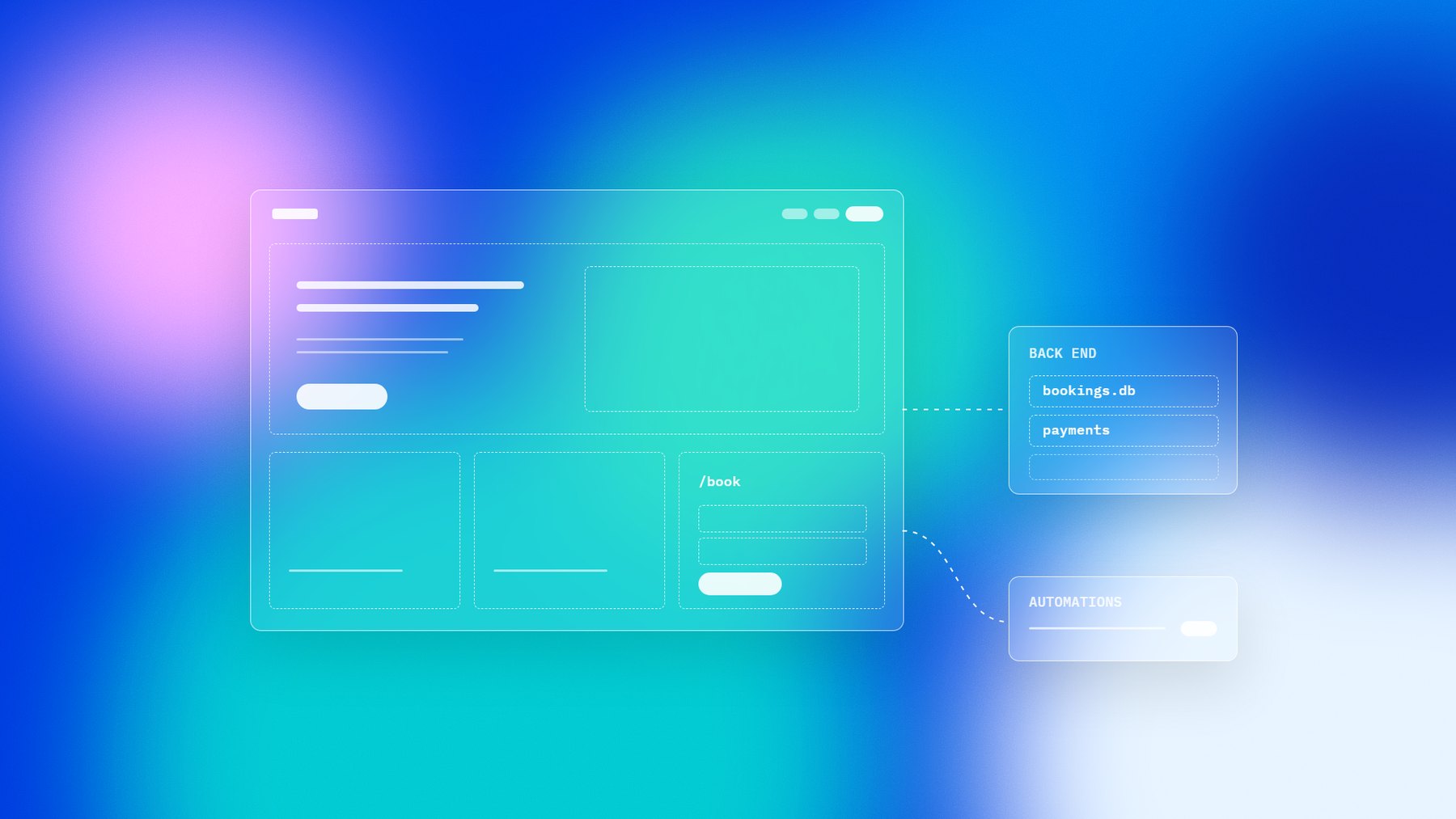
- The front end: every page your customers see, tap and scroll, built to feel fast on a phone first
- The back end: forms, bookings, payments and email that actually reach you
- Hosting: set up in the cloud so the site stays quick and stays up
- Connections: links to the tools you already run, so new leads land where you work
- Findability: search basics, business details and Google set up from day one
The same studio designs it and builds it, so nothing gets lost between a designer's mockup and a developer's guess.
How do you decide what goes on each page?
We plan the page before we design it. A homepage usually runs in this order: a hero that says who you are and what to do next, proof that you're trusted, what you offer, the story or process behind it, a final call to action, and a footer with your contact details and hours.
Every section gets one job and one next step, and nothing goes on the page just to fill space. We'd rather ship a shorter page that's true than a longer one that's padded.
We also read the playbook for your industry before the first call. A restaurant, a contractor and a detailer get asked different questions by their customers, so their sites answer different questions.
Where do the photos and video come from?
From a mix, chosen by the job each image has to do. Anything that proves something, like your space, your team, your work and your results, comes from real photos and video of your business or from media you already have. That's the proof, and we never invent it.
That footage often becomes the hero: a scroll-driven video where your place moves as the visitor scrolls. We can clean it up, fix the light and remove a stray reflection, but it stays your place.
Where does AI imagery fit?
In the feel of the brand. Some images aren't there to prove anything. They set a mood: the calm of a counseling practice, the energy of a gym, the polish of a boutique. That's where AI-made visuals help. We direct them from your design file, so every image shares the same light, colour and tone, and the site gets a consistent look without the generic feel of stock photos.
The rule is simple. Real images for proof, AI for atmosphere, and nothing made up that a customer could mistake for your actual shop, staff or results.
How do you keep it looking premium on every page?
Before we build anything, we write a design file for your brand: three words for how it should feel, your colours, your fonts, your spacing, how images should look and what is allowed to move. Every page is built from that file and nothing else.
That's why the tenth page looks like it belongs with the first. It also means a colour change later is one small edit, not a hunt through the whole site.
Motion is kept for the moments that matter: sections coming into view and the main buttons. Body text stays still. If an animation doesn't help someone book, it doesn't go in.
What does the process look like?
The same steps, in the same order, every time.
- Brief: what the site must do, who it's for, which pages, your brand assets, sites you like, and the photos or video you have
- Direction: we come back with the plan, the page structure and the look, and nothing gets built until you say yes
- Footage: we cut, clean and compress the real media for the web
- Build: one section at a time, each checked against your design file, at phone width, and for whether it sounds like you
- Checks: every page at phone, tablet and desktop sizes, every form tested, every button clicked
- Private preview: a link only you can see, marked as a preview, so you can review it on your own phone
- Launch: your domain, security, search setup and Google profile connected once the project is paid
- Handover: your logins, how to ask for changes, and who to call
How do you make sure it actually works?
We test it the way your customers will use it. Pages are checked at 375, 768 and 1440 pixels wide. Every form is sent for real. Every image gets a description for screen readers and search. Every page gets its own title. There's a proper 404 page in case a link ever breaks.
We run the finished site through Google's speed test and aim for the page to load its main content in under 2.5 seconds, with nothing jumping around as it loads. Then we spend five minutes clicking every button and reading every headline out loud. That habit catches more than any automated check.
Will people be able to find it?
A site nobody finds is a brochure in a drawer. Every build includes the search groundwork: unique titles and descriptions, a sitemap, structured data that tells Google your name, address, phone and hours, and Search Console set up and checked after launch.
We also make sure your Google Business Profile matches the site exactly, down to the comma. When those details disagree, search engines trust both less.
What does a finished build look like?
Footed By Reesey restores sneakers in Powder Springs and across Metro Atlanta. Her site has 23 pages, a four-step booking flow with Stripe deposits and invoices, monthly care plans, and follow-up emails when someone starts a booking and doesn't finish. It also has a photo scanner that reads a customer's shoes and gives an instant first look, flagging unusual pairs for her to check herself.
That's the level we build to: the front of the shop and the systems behind it, working together.
Who is this for?
Owners who are good at what they do and tired of a website that doesn't show it. Usually that means a local service business with real work to show: a shop, a studio, a practice, a crew. If customers already love you once they walk in, the site's job is to get them through the door.
If you only need a single page with your hours and a phone number, we'll tell you that. Not every business needs a full build.
You don't need more pages. You need the right ones, built to book.