

For years, bigger meant safer. A large agency had more people, more departments and more cover, so hiring one felt like the careful choice.
That logic is breaking down. Not because big agencies got worse, but because the tools changed what a small team can carry. Work that once needed a designer, a developer, a copywriter and a project manager in four separate seats can now be done well by a small senior team that knows what it's doing.
We're Hatsumei, a small Atlanta studio for websites, automation and brand visibility. Here's why we think small is the advantage right now, not the compromise, and how to tell if it's the right fit for you.
Does having AI tools still set anyone apart?
No. That part is over.
The Stanford HAI 2026 AI Index puts organizational adoption at 88%. Nearly everyone you could hire has access to the same models, the same coding assistants and the same image tools.
So the tools aren't the edge. What a team does with them is.
And most teams aren't getting much from them yet. In BCG's September 2025 study of 1,250 senior executives, only 5% of companies counted as "future-built" for AI. 60% reported minimal revenue and cost gains. BCG's point was blunt: companies need to redesign how work gets done, not just bolt AI onto the old way.
That's the opening for a small studio. Redesigning how work gets done is hard when your process runs through six departments. It's easy when the people who decide and the people who build sit at the same table.
What do the layers actually cost you?
In a traditional agency, you talk to an account lead. They write a brief. The brief moves to strategy, then design, then development. Each hand-off loses a little of what you meant.
Nobody in that chain is doing a bad job. The structure is the problem. Every layer adds a meeting, a wait, and one more chance to misread you.
The modern workday makes it worse. Microsoft's 2025 Work Trend Index found that heavy Microsoft 365 users are interrupted every 2 minutes by a meeting, email or notification. 48% of employees and 52% of leaders said their work feels chaotic and fragmented.
Now picture your project moving through that, four hand-offs deep.
With us, there's no translation step. Jonah, our founder, is on every project from the first call. You tell us what's slowing you down. The team that hears it is the team that fixes it.
Fewer layers doesn't mean less care. It means fewer places for your meaning to get lost.
What changed in the tools?
Coding assistants now handle a lot of the typing. In a controlled experiment on GitHub Copilot, developers with the tool finished a set task 55.8% faster than those without it. Cloud platforms now handle hosting, scaling and security that used to need a dedicated team.
That doesn't make the work easy. It moves the hard part.
The hard part is now judgment. What to build. What to leave out. What will still work in a year, when the person who asked for it has moved on to the next problem.
It's also why "we'll just build it ourselves with AI" so often stalls. The same Stanford report notes that AI agents still fail roughly 1 in 3 attempts on structured benchmarks. A tool will happily produce a booking page in an afternoon. It won't tell you it breaks when two people book the same slot, or that it quietly stopped running last Tuesday.
Fast output and a working system aren't the same thing. The gap between them is where a senior team earns its keep.
How fast can a small studio really move?
Faster than most people expect, because the people who spot the problem are the people who fix it. A small team sees a repeated job, builds a system for it, puts a check on every output and keeps it running. That used to be a department's work.
Here's what that looks like in client work. For Smyrna Couples Counseling, that meant a referral router that sends the clear cases where they belong and holds anything unclear for a person to decide. For Footed By Reesey, a sneaker restoration business in Powder Springs, it meant a site and booking flow shaped around how she actually takes in work.

What does the loop look like?
Every system we build, for us or for a client, runs through the same four steps.
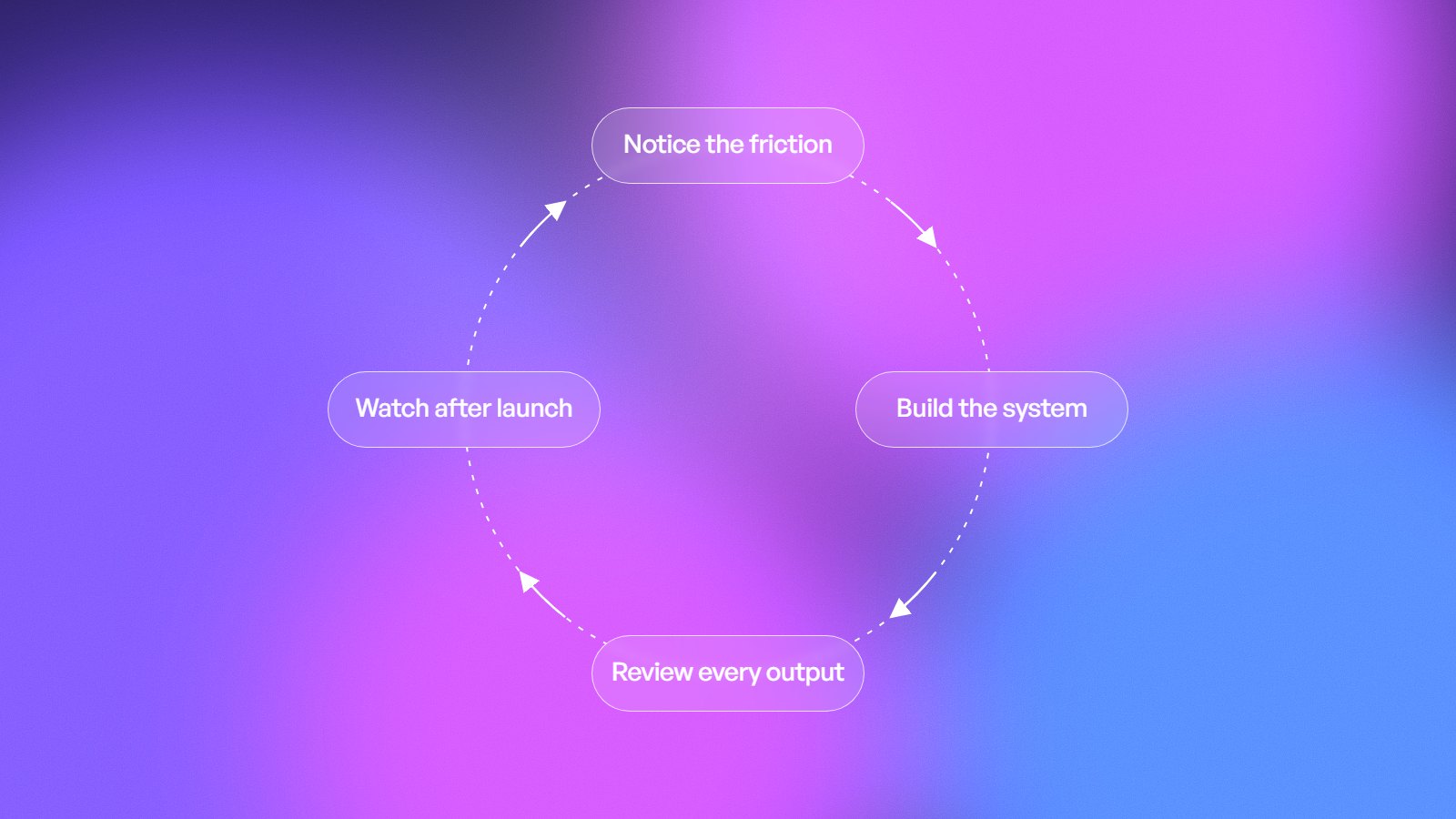
Notice. Find the friction that repeats. Not the big strategy problem. The small job that eats time every day and lives in someone's head.
Build. Make the system that handles it, ideally inside tools the business already uses.
Review. Check every output, not a sample. On a website, that's every page checked on a phone and a laptop before launch. In a counseling practice, it's a safety net that holds anything uncertain for a human.
Watch. Keep an eye on it after launch and fix things before anyone notices. Then find the next friction and go round again.
A big team can run this loop too. It just runs slower, because each step sits with a different department and each hand-off needs a meeting. When one small team owns all four steps, the loop turns in days, not quarters.
Isn't a small studio a risk?
It's a fair question. What if we get busy, or something changes?
The real risk is in how things are built, not how many people built them. We build on accounts you own and can see: your domain, your hosting, your Google account. Nothing is locked inside a system only we can open.
Big agencies lose account leads all the time. When they do, the new person starts from zero. With us, the people who built it are the people who answer.
There are honest limits. A small studio can only take on so much, so we take on fewer projects and finish them properly. If you need a dozen specialists working in parallel next month, a larger shop is the better call.
What should stay slow?
Not everything should be automated. Some things are worth doing by hand.
- The first conversation. We want to hear how your business actually runs, in your words.
- Taste. Tools can make a page. They can't tell you whether it feels like you.
- Anything that touches a relationship. An upset client should hear from a person.
Being small makes these easier to protect. We're not chasing utilization targets, so we can spend the time where it counts.
Who is this a good fit for?
Owner-led businesses, mostly. Clinics, counseling practices, law firms, accountants, real estate teams, creative studios and local service brands.
Three questions decide it:
- Do you want to talk to the people doing the work?
- Is the job one system or a handful, not a hundred people's worth?
- Do you want decisions made in days, not committee meetings?
If the answers are yes, we're probably a good fit.
FAQ
Is Jonah really on every project? Yes. He leads every project from the first call through launch and after it.
Do you work with my team or just with me? Whoever runs the process. We talk to the people who do the work today, because they know where it actually breaks.
What happens after launch? The systems keep running and we keep watching them. Launch is the start, not the hand-off.
Want to talk it through?
If something in your business eats time every day, tell us about it. On a short call we'll tell you plainly whether we can fix it and what we'd look at first.