
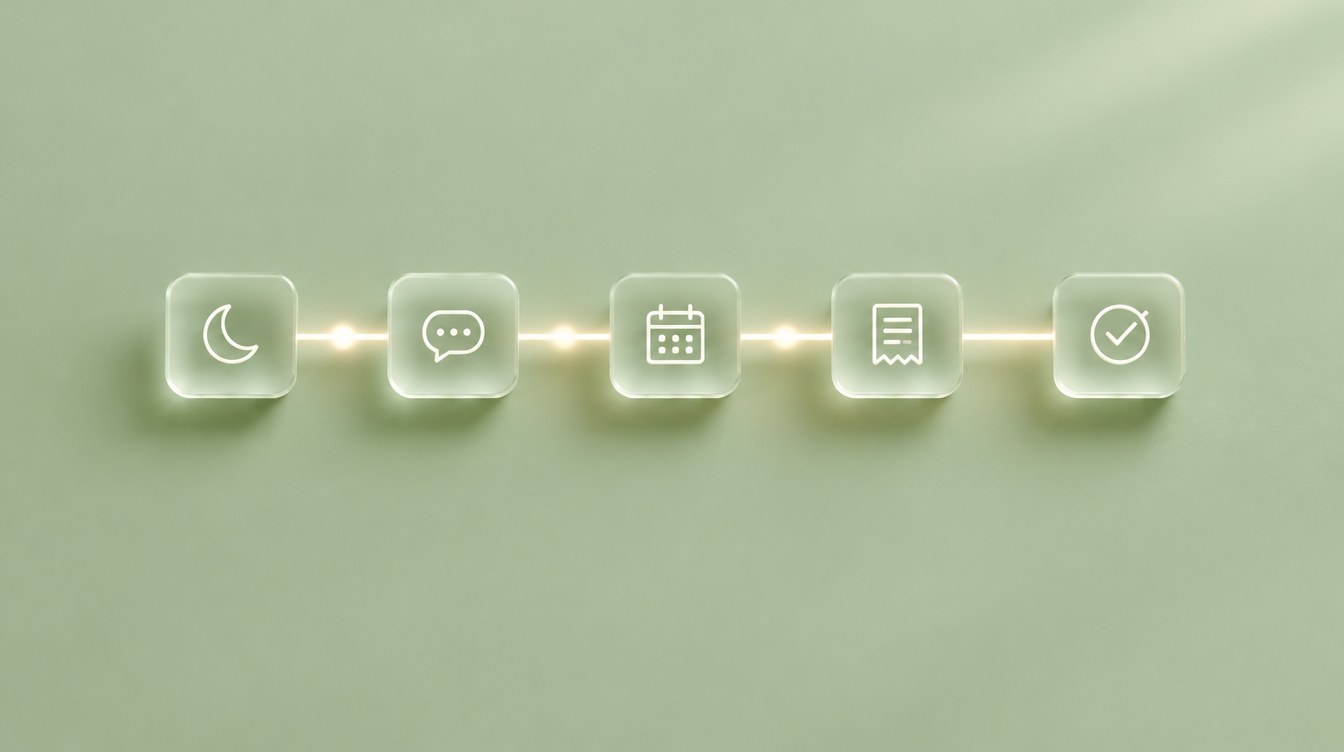
You finish the last job. You lock up. Then the second shift starts.
There's the inquiry that came in at lunch. The customer who started a booking and never finished. The deposit you still need to request. The spreadsheet you meant to update on Friday. None of it is hard. All of it is yours, because nobody else knows how it works.
That's the shift we build systems to take over.
The second shift is made of small steps
Ask any owner to walk through a normal week, and leave out the big decisions. What's left is a list of small, repeated steps.
The pattern is familiar. Someone reaches out. The owner reads it, copies the details somewhere, decides who should handle it, replies, and makes a mental note to follow up. Five minutes here. Ten there.
On its own, each step is nothing. Together they fill an evening. And because they live in the owner's head, they stop the moment the owner does.
What did a counseling practice's second shift look like?
Smyrna Couples Counseling is run by Jena Irvin, who leads a team of associate therapists. New clients reach out through the practice's website.
Every one of those referrals used to land on Jena. Read it. Log it in the sheet. Work out which associate had room. Forward it. Five or six minutes each, on top of running a practice.
Now an automation inside her own Google Workspace does that hand-off in one to three seconds. It reads each referral, fills the sheet, matches an associate on a balanced rotation, and forwards it. Anything that doesn't read like a real client is held for a person. The associates' caseloads went up, because new clients stopped waiting in an inbox. We wrote about the build in From five minutes to two seconds.
The point here isn't the technology. It's that a job which had quietly become part of the owner's day turned out to be a rule.
Four jobs a system can take
Most of the second shift falls into four jobs.
- Answer. Questions get a real reply, at any hour, in a voice that sounds like your business.
- Book. Customers pick a time, pay what's due, and land on your calendar without a back-and-forth.
- Chase. Unfinished bookings and quiet leads get a polite nudge without you remembering to send it.
- Report. You know the state of things without digging.
Footed By Reesey, a hand sneaker restoration studio in Metro Atlanta, has the first three working for her. An assistant answers by chat and voice with her personality. A four-step booking flow takes Stripe deposits and invoices. Follow-up emails go to anyone who starts a booking and walks away. She still does the part only she can do, at the bench.
The value isn't in any one tool. It's in the hand-offs between them happening on their own.
How do you judge what's worth automating?
Not everything repetitive is worth building. We use three questions. We call them Often, Obvious, Cheap.
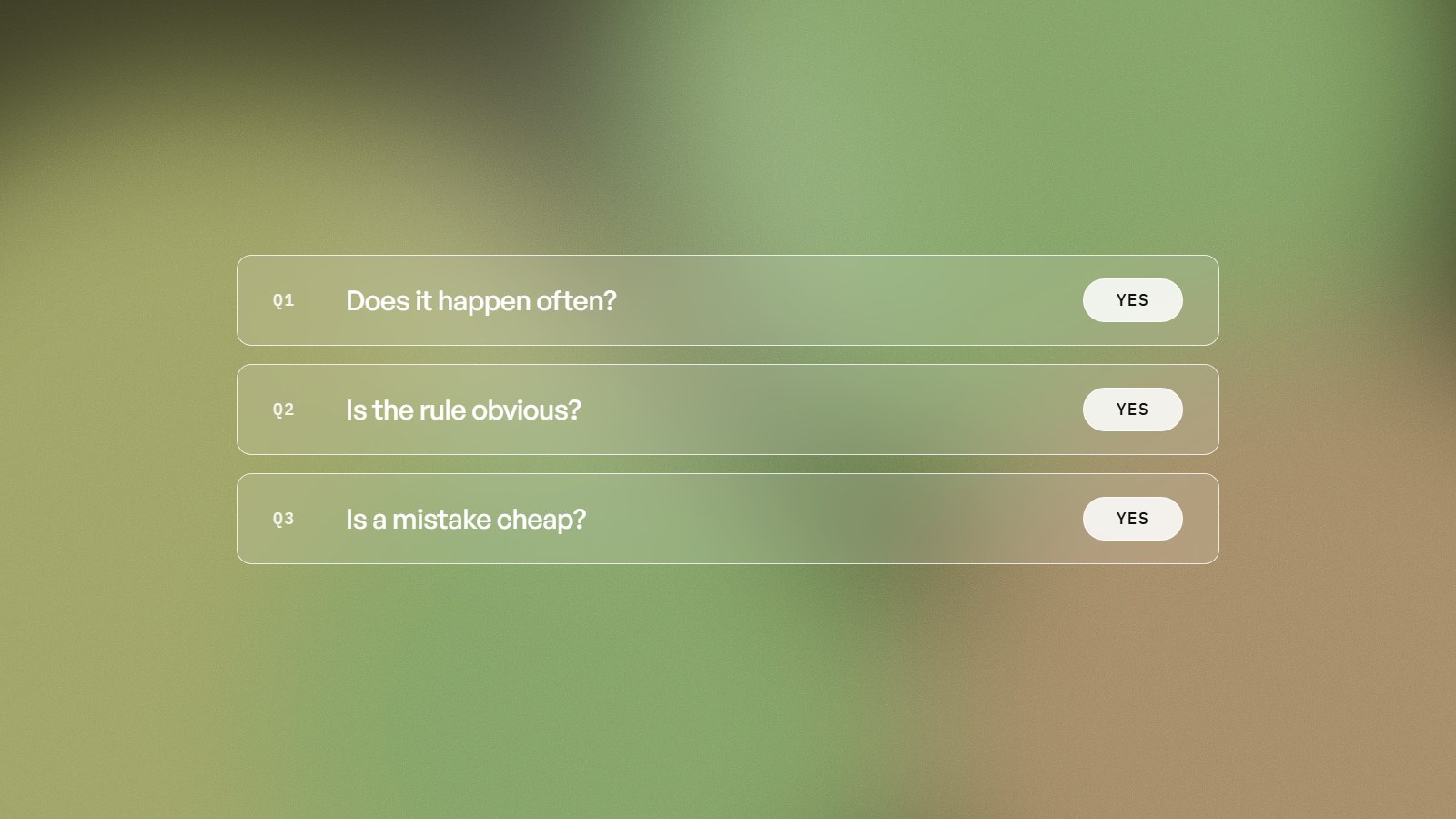
Does it happen often? A task you do twice a year isn't worth a system. A task you do every day, or every time a customer arrives, usually is. Frequency is what turns five minutes into an evening.
Is the rule obvious? Could you explain the decision to a new hire in one sentence? "Referrals go to whoever's turn it is" is obvious. "It depends on the client" isn't, at least not yet.
Is a mistake cheap? If the system gets one wrong, how bad is it, and how fast would you know? A late reminder email is cheap. A missed client isn't. When a mistake is expensive, the system needs a person on the hard cases.
Three yeses is a strong candidate. Two yeses usually still means yes, with a different build. More checks. A person in the loop for longer. One yes often means a better habit beats a system. Knowing which is which is most of the job.
Often, obvious, cheap. Three yeses and the task shouldn't be yours anymore.
Why do so many automations get switched off?
Because they were built for the happy path.
It's easy to connect two apps so that a form fills a sheet. It works in the demo. Then a real customer types their phone number in the name field. A payment fails halfway. Someone books, cancels, and books again. A vendor's pitch gets treated like a client. The assistant is asked something it doesn't know and makes up an answer. A connection expires quietly and nothing runs for a week, and nobody notices until a customer complains.
Each of those is small. Any one of them is enough for an owner to stop trusting the system and go back to doing it by hand.
A system you have to check on isn't saving you time. It's moved the work somewhere you can't see it.
Judgment stays with you
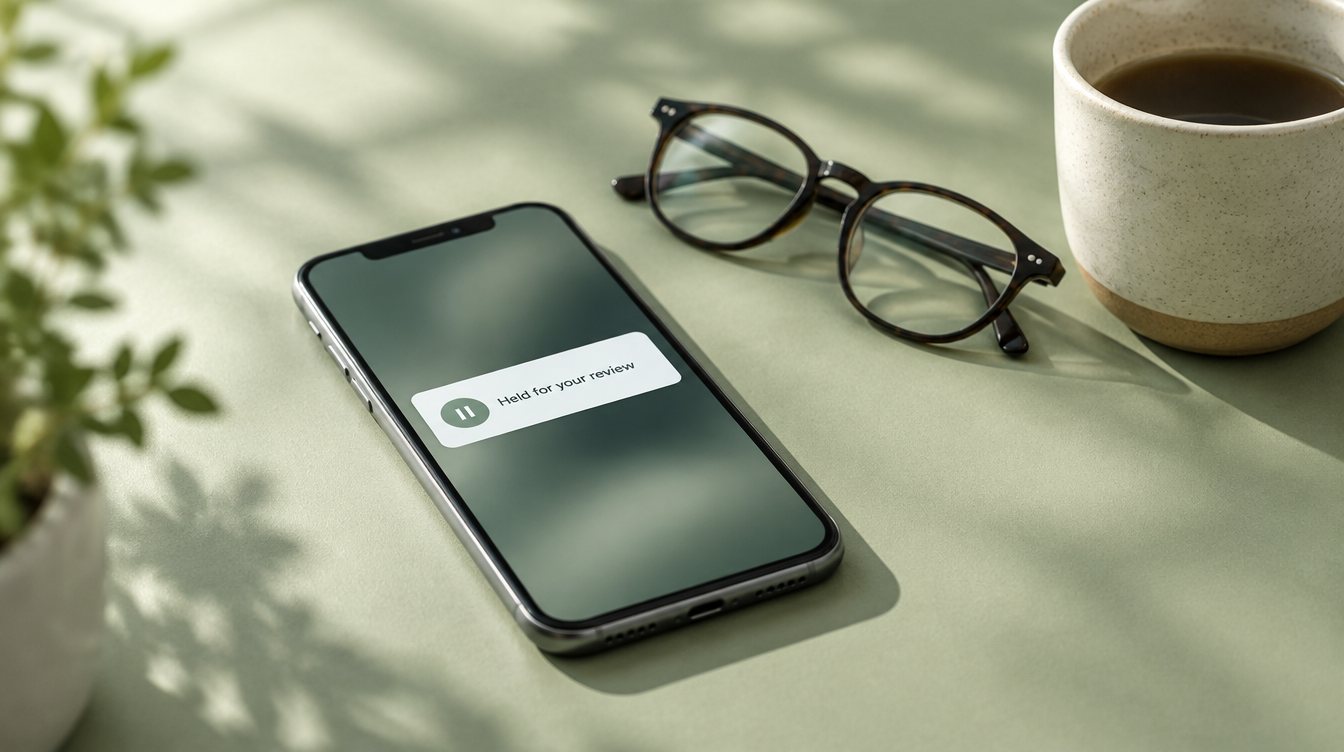
Automation is good at rules. It's bad at judgment. So every system we build draws a clear line between the two.
In Jena's referral system, anything that doesn't read like a real client is held for a person. In Reesey's shoe-photo scanner, an unusual pair goes to her instead of getting a guess. A refund or an odd request goes to the owner, not to a script.
The goal isn't to remove you from the business. It's to make sure the only things that reach you are the things that need you.
What does waiting cost?
The second shift doesn't stay the same size. As a business grows, every new customer adds a few more small steps. Owners tend to absorb them one at a time, without noticing, until the evenings are gone.
There's a quieter cost too. Every task that lives only in your head is a task nobody else can pick up. That makes it harder to hire, harder to take a week off, and harder to grow without simply working more.
FAQ
Will my customers know they're talking to a system? They should. An assistant can be warm and sound like your business, but it shouldn't pretend to be you.
Do I need new software for this? Usually not. Most of what we build runs inside tools you already use.
What happens when something goes wrong? Every system we build has a fallback. When it isn't sure, it stops and hands the item to a person instead of guessing. And it keeps running after launch because we keep watching it.
Get your evenings back
If there's a part of your week that keeps following you home, we'd like to hear about it. Tell us what repeats, and on a short call we'll tell you which piece we'd take off your plate first, and which we'd leave alone.