

For years, a small business website was a brochure. A few pages, some stock photos, a phone number and a contact form. You paid for it once and forgot about it.
That model is finished. Customers now expect to see what you do, check you out, and book or buy without waiting for anyone. More of them never type your address at all. They search Google, read your reviews, ask an AI tool for a recommendation, and land on your site already half decided. What they find there decides the rest.
This piece covers what a website has to do in 2026, why it's the most valuable thing your business owns online, and what actually brings in more leads and sales. It's also how we build every site at Hatsumei.
Why is a website the most valuable asset you own online?
Because it's the only one you actually own.
Your Instagram, your Facebook page, your TikTok and your listings on other people's platforms are all rented. The platform sets the rules, decides who sees your posts, and can change any of it overnight. You build an audience there, but you don't control the road between that audience and your business.
Your website is different. You own the domain, the content, the design and the data. Nobody can throttle it, bury it under someone else's ads, or shut your account. Every other channel you use can point to it, and it keeps working while you sleep.
That matters more than most owners think, because the platforms you rent rarely send customers who are ready to buy. Footed By Reesey, a sneaker restoration studio in Metro Atlanta we work with, is a good example. She's active on Instagram and it builds her brand. But when we looked at her data, one visit from Google was worth roughly 26 visits from Instagram. People scrolling a feed are passing time. People searching are looking for someone to hire.
Social media is where people meet you. Your website is where they decide to become customers.
It's also the center of your digital brand: the one place where your story, photos, prices, reviews and booking sit together, told your way.

Your website is the experience before the purchase
Most owners miss this: customers experience your business before they ever walk in, call, or pay.
They see the room before they sit in it. They see the work before they hand over their car, their shoes or their kitchen. They get a feel for how you treat people from the way your site treats them. A slow, confusing, out-of-date site tells them something about you, whether that's fair or not.
People really do judge this way. The Stanford Web Credibility Project, built on three years of research with over 4,500 people, found that people quickly judge a site by its visual design alone. Its guidelines are plain: show there's a real organization behind the site, make your claims easy to verify, and design the site so it looks professional for its purpose.
That's why we build from real footage and real photos of the business, never stock images and never generated video that pretends to be your shop. The opening of a site we build is often a scroll-driven video: the visitor scrolls and walks through your front door, into your space, past your work. It feels expensive, but its real job is honesty. The customer sees exactly what they'll get, before they've spent a cent. And every fact on the page, from hours to prices to reviews, has a source. If we can't confirm it, it doesn't go on the site.
What does a website have to do in 2026?
A website in 2026 has six jobs. We think of them as a stack, because a visitor moves down through them in order.
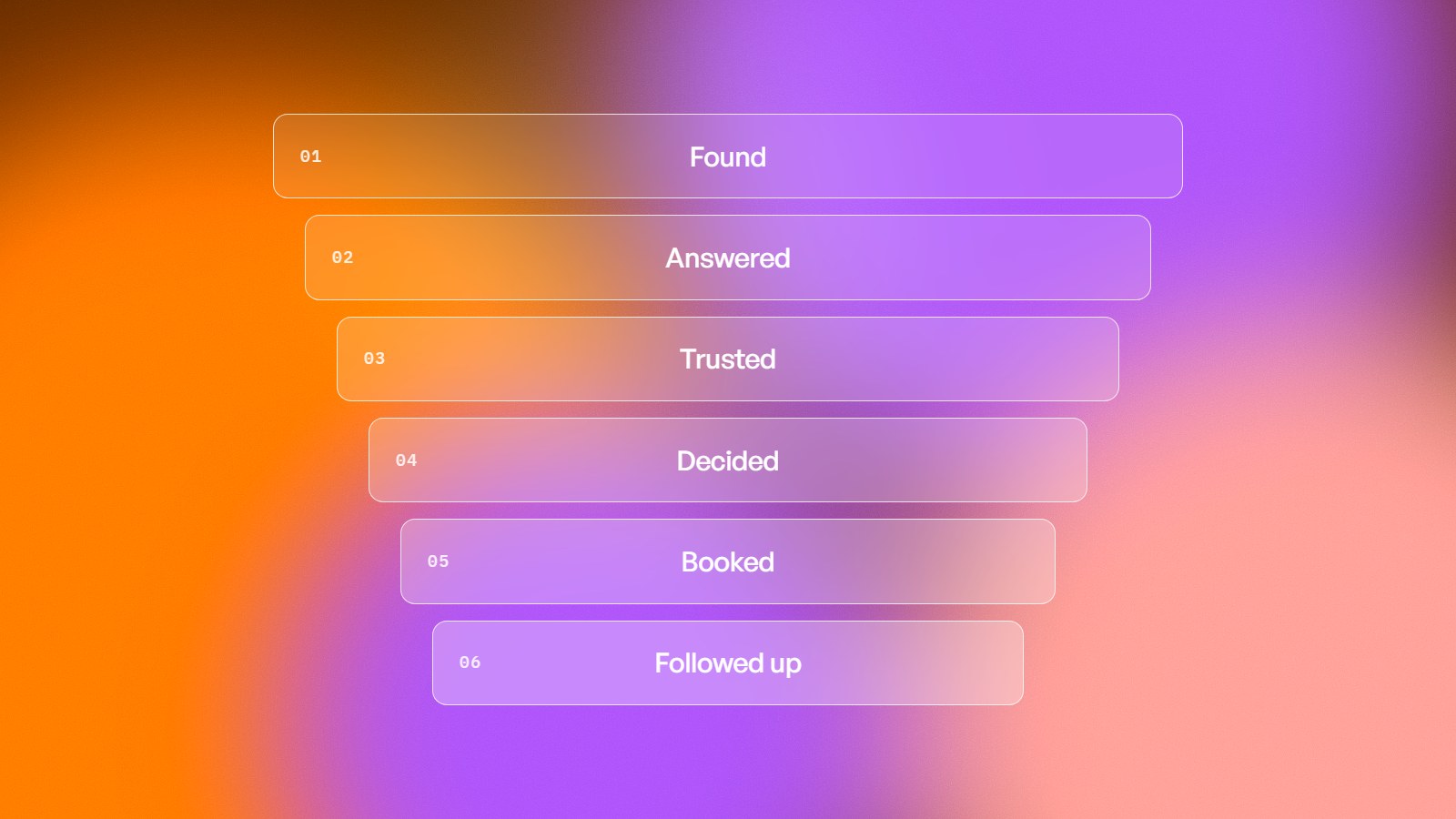
- Get found. Google, Google Maps and AI tools can tell exactly what you do, where, and for whom, so you show up when someone searches.
- Answer. The questions every customer asks, like price, hours, area, how long it takes and what happens next, are answered on the page, even when you're busy or closed.
- Build trust. Real photos, real reviews, real people and real details prove you're the business you say you are.
- Help them decide. Someone unsure gets help choosing the right service, package or next step.
- Book or buy. They can go from "I'm interested" to "I'm booked" or "I've paid" without waiting on a call back.
- Follow up. The site keeps the relationship going after the first visit: confirmations, reminders, a nudge to someone who started booking and stopped, and a request for a review once the job is done.
If the top layer fails, nobody arrives. If the bottom layers fail, everyone who arrived leaves at the last step. Most small business sites are decent at one layer and silent on the rest.
The way we lay out a homepage follows the same logic. Every section has one job and one call to action. The hero says what you do and where, with the main action in reach. Then a trust strip. Then the offering. Then the proof: your process, your gallery, your story. Then a final call to action and a footer with your address, phone and hours. If a section doesn't have a job, it doesn't go on the page. A restaurant without a private dining room doesn't get a private dining section just because a template had one.
Why is getting found the job most owners don't know about?
Because it's invisible. A site nobody finds looks the same to its owner as one with a hundred visits a day. Nothing breaks. The phone just doesn't ring.
Getting found has three parts, and they all have to agree with each other.
Google search. Each page needs a clear title, a clear description and words that match how people actually search. That's why we build one page per service instead of one page that lists everything. An auto repair shop gets a page for "brake repair in Marietta" and another for "diesel repair in Marietta", because those are the searches that bring in jobs. We add structured data, small pieces of code that tell Google your name, address, phone, hours and ratings in a language it reads directly. We submit the site to Google Search Console, send the sitemap, and check for errors after launch.
Your Google Business Profile. This is the listing that shows up on Google Maps and in the box of local results. For a local business it's often the first thing a customer sees. Google says local results are based mainly on relevance, distance and prominence. Relevance is how well your profile matches the search. Prominence is how well known you are, which includes links to your business and how many reviews you have. Google also says plainly that more reviews and positive ratings can help your local ranking, and that there's no way to pay for a better spot.
The profile and the website have to tell the same story. Your name, address and phone on the site should match the profile character for character. Your services and categories should use the same words. When they disagree, Google has to guess, and it doesn't guess in your favor.
AI search. More people now ask Google's AI answers or ChatGPT "who's the best sneaker cleaner near me" and get a short list of names. There's a lot of noise about special tricks. Google's own guidance is simple: there are no additional requirements to appear in AI Overviews or AI Mode. The page has to be indexed and eligible to show in normal search. Google's best practices are the fundamentals: let it crawl the site, keep important content in text rather than baked into images, make sure your structured data matches what's visible on the page, and keep your Business Profile current.
In other words, AI search rewards the same thing good SEO always did: a site that says clearly what you do, where, and for whom, backed up by the rest of the web. A clever homepage with your services hidden in a slideshow loses to a plain one that says it straight.
If a machine can't tell what you do and where, it won't recommend you. It'll recommend someone it understands.
What actually brings in more leads and sales?
A good-looking site is the starting line. These six things move the number of calls, bookings and sales.
Speed
People leave slow sites, and they leave fast. Google's research found that 53% of mobile visitors leave a page that takes longer than three seconds to load, and that as load time goes from one second to seven, the chance of a visitor bouncing rises 113%. Those numbers are from 2017. Patience has not improved since.
Speed also shows up directly in revenue. Deloitte's Milliseconds Make Millions study found that a 0.1 second improvement in mobile site speed lifted retail conversions by 8.4% and travel conversions by 10.1%.
Google measures this with three numbers it calls Core Web Vitals: the main content should load within 2.5 seconds, the page should respond to a tap in under 200 milliseconds, and the layout shouldn't jump around while it loads. Google strongly recommends good scores for success in Search. We check every site we build against them before it goes anywhere. A video hero is only allowed if it's compressed hard, loads a still frame first, and still works as a still image with no motion at all.
Mobile first, for real
Most of your customers will see your site on a phone, often in a hurry. A mechanic's customer might be on the side of the road. A restaurant's customer is hungry and deciding in the next two minutes.
So we design for the phone first and check every section at 375 pixels wide, the size of a small phone. One test we use on every build: can a hurried customer find the main action, whether that's call, book, menu or directions, in one thumb movement? If not, the section isn't done.
A clear offer
Say what you do, where, and for whom, in the first screen, in plain words. Then show your services with real names, real details and, where you're comfortable, real prices or starting prices. Vague copy like "quality solutions for all your needs" makes people work to understand you. Most won't.
Button text matters too. "Book my cleaning" or "Request my appointment" in your own voice does better than "Submit" or "Learn more", because it tells people exactly what happens when they tap.
Proof and reviews
Reviews are now part of almost every buying decision. BrightLocal's Local Consumer Review Survey 2026 found that 97% of consumers read reviews for local businesses, and 85% are more likely to use a business after reading positive ones.
Here's the number that should get every owner's attention: after reading a positive review, 54% of consumers go to the business's website, up from 32% in 2019. Your reviews send people to your site. If there's no site, or a weak one, that trust leaks away at the moment it's highest.
We show real reviews on the site with names and dates, linked back to Google, and we never write or edit review text. After launch, we help you ask your first happy customers for Google reviews, because more reviews help both your ranking and your conversion.
Other proof works the same way: real photos of your team and work, before and afters, licenses and guarantees, all confirmed.
Booking and checkout that don't lose people
Every extra step costs customers. Baymard Institute's research puts the average online cart abandonment rate at 70.22%. Among the fixable reasons, 18% of shoppers left because they were asked to create an account and 17% because checkout was too long or complicated. Baymard estimates the average large online store could lift conversions by 35.26% through better checkout design alone.
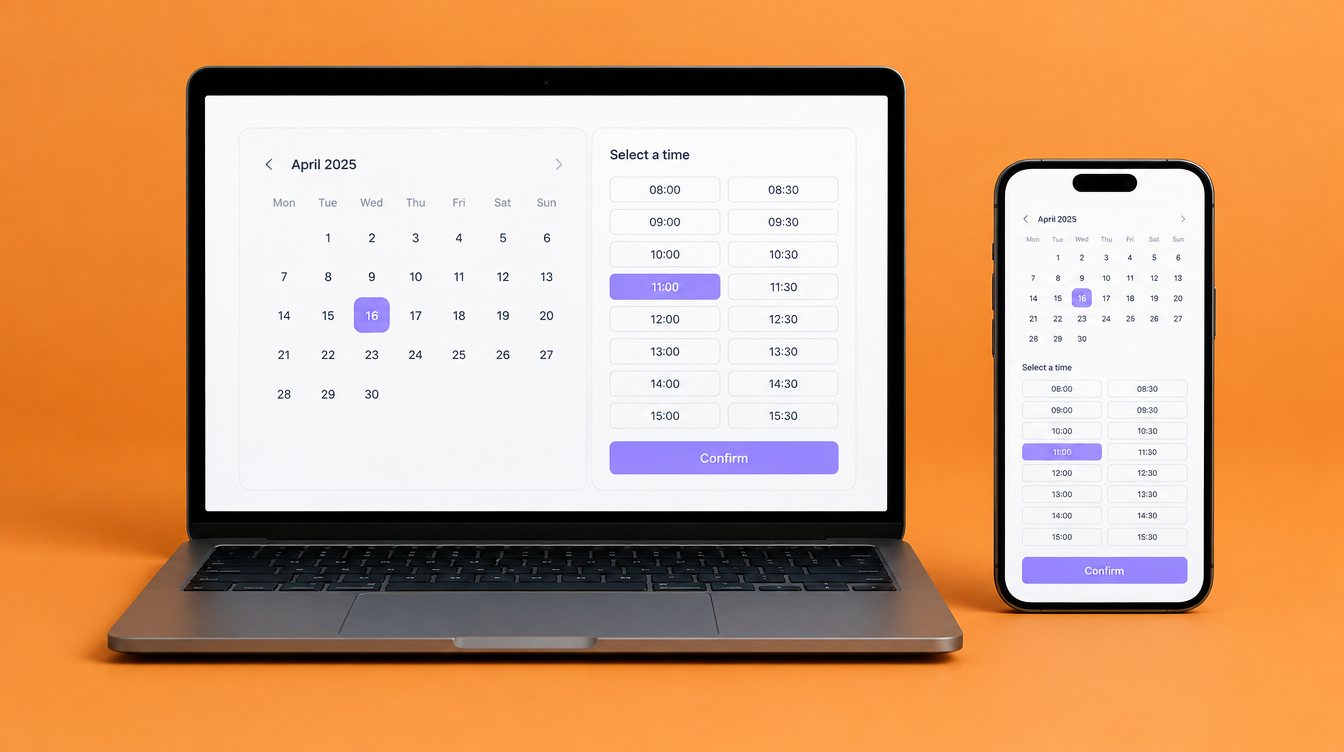
A local service business isn't an online store, but the lesson carries over. Ask only for what you need. Let people book a time, pay a deposit or request a quote right on the site. Don't make them call during your working hours to do something a form could do at 11pm.
Reesey's site shows how far this goes: a four-step booking flow with deposits built in, monthly care plans for regulars, and an email follow-up when someone starts a booking and doesn't finish. Each piece hides small decisions. What do you ask in step one without scaring people off? When do you stop following up? Get them wrong and the flow quietly loses the customers it was built to catch.
Tracking
Without tracking, you're guessing. We set up analytics and Search Console so you can see which searches bring people in, which pages they read, and how many book. That's how we knew a Google visit was worth about 26 Instagram visits for Reesey.
Does every business need all six jobs?
Every business needs all six layers. Not every business needs the same tools in each one.
A plumber doesn't need a product checkout. A counselor might not want an online chat. For a law firm, "book" might mean a consultation request, not a deposit. A restaurant's "decide" layer is a menu that's easy to read on a phone. An auto shop's "trust" layer is honest pricing, certifications and real photos of the bays, not a dealership-slick look.
That's why we keep a playbook for each industry we build for: what that customer needs to see, which pages rank, and what booking looks like. The structure stays the same. The details fit how your customers buy.
Why a site built this way costs more than a template, and why it's worth it
A template site can be cheap and quick. What it usually can't do is the work above: one page per service, structured data, a matched Google profile, real footage, booking, follow-up, speed checks and tracking. Those are where the leads come from.
Here's the simplest way to think about the cost. What is one new customer worth to you over a year? For a restaurant, a regular who comes in once a month might be worth several hundred dollars. For a contractor or a dental practice, one new client can be worth thousands. If a site brings in just two or three extra customers a year, it usually pays for itself. Everything after that is profit from an asset you own.
How we run a build is part of the value too:
- A written design system first. Your colors, fonts, spacing and voice are set before any page is built, so the site feels like one brand.
- Real media only. We film or photograph your business, or work from what you send. Edits are limited to light and polish, and you see them first.
- Built a section at a time. Each section is checked against the design, on a phone, and for your voice before we move on.
- A private preview first. You see the whole site on a private link and approve it before it goes on your domain.
- Launch is a checklist. Domain, security certificate, forms tested end to end, structured data, Search Console, and your Google profile matched to the site.
- It keeps working. Menus, services and seasons change. We keep an eye on speed, search errors and your profile after launch, so the site never drifts out of date.
FAQ
I already have Instagram and a Google profile. Do I really need a website? Yes. Both are valuable, and a good site makes both work harder. After reading a positive review, more than half of consumers go to the business's website next. The site is where they book, and it's the one channel you own.
Is SEO something I can do later? You can, but it's much cheaper to build it in. Page structure, service pages and structured data are decided at the start. Adding them later often means rebuilding.
Do I need special tricks for AI search? No. Google says there are no special requirements. A clear, fast, honest site that matches your Google profile is what gets you named.
How fast will I see results? Speed and clear booking help from day one. Search visibility builds over weeks and months as Google crawls the site and your reviews grow.
Is your site doing all six jobs?
If your website still works like a brochure, or you don't have one yet, we'd like to see where you stand. Send us your site or your Google profile, and on a short call we'll tell you which of the six jobs it's missing and which one we'd fix first.